


Intro
Cybercrime has evolved rapidly over the past decade, and one of the most dangerous threats facing businesses today is ransomware. Organizations around the world are losing millions of dollars each year due to ransomware attacks that encrypt data and demand payment for its release. From hospitals and financial institutions to government agencies and small businesses, no organization is completely immune to this growing cyber threat.
Cybersecurity experts play a crucial role in protecting organizations from ransomware attacks. By using advanced monitoring tools, security strategies, and threat intelligence systems, professionals can detect suspicious activities and stop attacks before they cause serious damage.
In this article, we explore how cybersecurity experts prevent ransomware attacks and the strategies they use to keep organizations secure.
What Is a Ransomware Attack?
Ransomware is a type of malicious software designed to block access to a computer system or encrypt data until a ransom is paid to the attacker. Once the malware infects a device or network, it locks important files and demands payment, usually in cryptocurrency.
Ransomware attacks typically spread through:
- Phishing emails with malicious attachments
- Infected websites or software downloads
- Exploited software vulnerabilities
- Weak or stolen login credentials
- Remote desktop attacks
Once the ransomware infiltrates a system, it quickly encrypts files, making them inaccessible to users and organizations.
Why Ransomware Attacks Are Increasing Worldwide
Ransomware attacks have become more frequent and sophisticated in recent years. Several factors contribute to this increase.
Rapid Digital Transformation
Businesses rely heavily on digital systems, cloud platforms, and remote networks. This expansion creates more opportunities for cybercriminals to exploit vulnerabilities.
Remote Work Environments
With employees accessing company networks from different locations, security risks have increased significantly.
Lack of Cybersecurity Awareness
Many employees are unaware of cyber threats such as phishing emails and malicious downloads, making them easy targets for attackers.
Outdated Software and Systems
Organizations that fail to update their systems regularly become vulnerable to ransomware attacks.
Because of these risks, companies increasingly depend on trained cybersecurity professionals, many of whom obtain certifications from organizations like EC-Council to develop advanced cyber defense skills.
How Cybersecurity Experts Detect Ransomware Early
Early detection is one of the most effective ways to stop ransomware attacks before they spread across a network. Cybersecurity experts use several advanced technologies to identify threats.
Network Monitoring
Cybersecurity teams constantly monitor network traffic to detect unusual behavior. Suspicious data transfers or abnormal network activity can signal a ransomware attack in progress.
Endpoint Detection and Response (EDR)
Endpoint protection tools monitor devices such as laptops, servers, and smartphones connected to the network. If a device starts behaving abnormally, security systems can quickly isolate it.
Security Information and Event Management (SIEM)
SIEM platforms analyze system logs and security events from across the organization. These systems help cybersecurity experts identify patterns that may indicate ransomware activity.
Threat Intelligence Platforms
Threat intelligence systems collect information about known cyber threats and attacker tactics. This helps security teams anticipate and block ransomware attacks before they occur.
Key Strategies Cybersecurity Experts Use to Stop Ransomware
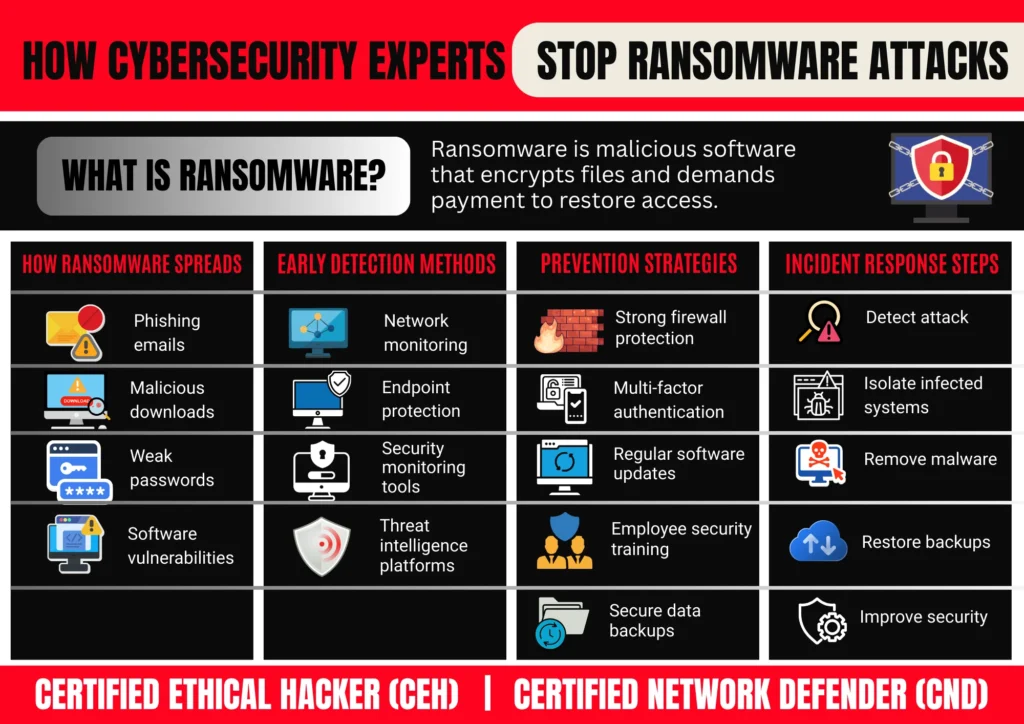
Preventing ransomware requires a combination of technical defenses, security policies, and employee awareness programs. Cybersecurity professionals rely on multiple strategies to keep systems protected.
Strong Firewall Protection
Firewalls act as the first line of defense against cyber threats. They filter incoming and outgoing network traffic and block suspicious connections that could carry ransomware.
Email Security and Phishing Protection
Many ransomware attacks start with phishing emails. Cybersecurity teams implement email security solutions that scan attachments and links to detect malicious content.
Multi-Factor Authentication (MFA)
Multi-factor authentication requires users to verify their identity using multiple methods such as passwords and mobile verification codes. This significantly reduces unauthorized access.
Regular Software Updates
Software vulnerabilities are common entry points for ransomware. Cybersecurity experts ensure operating systems and applications are updated regularly to close security gaps.
Data Backup and Recovery Systems
Regular data backups ensure that organizations can recover files without paying a ransom if an attack occurs.
Tools Cybersecurity Professionals Use Against Ransomware

Cybersecurity experts rely on a variety of tools and technologies to protect systems from ransomware attacks.
Some commonly used tools include:
- Antivirus and anti-malware software
- Endpoint detection and response systems
- Network intrusion detection systems
- Security monitoring platforms
- Backup and disaster recovery tools
These technologies work together to detect, block, and remove ransomware threats.
What Happens When a Ransomware Attack Occurs?
Cybersecurity expea
Despite strong security measures, some ransomware attacks still manage to infiltrate systems. When this happens, cybersecurity teams follow a structured incident response plan.
Step 1: Identify the Attack
Security teams quickly identify the type of ransomware and determine how it entered the system.
Step 2: Isolate the Infected Systems
The infected devices are disconnected from the network to prevent the ransomware from spreading further.
Step 3: Remove the Malware
Cybersecurity experts use specialized tools to remove the malicious software from affected systems.
Step 4: Recover Data from Backups
If secure backups exist, the encrypted files can be restored without paying the ransom.
Step 5: Investigate the Security Breach
Finally, experts analyze how the attack occurred and implement stronger security measures to prevent future incidents.
rts rely on a variety of tools and technologies to protect systems from ransomware attacks.
Some commonly used tools include:
How Businesses Can Protect Themselves from Ransomware
Organizations can significantly reduce ransomware risks by adopting strong cybersecurity practices.
Recommended security measures include:
- Implementing regular data backups
- Training employees to recognize phishing attacks
- Using strong password policies
- Conducting regular security audits
- Deploying advanced endpoint protection
- Enforcing network access controls
Cybersecurity awareness training is especially important because human error remains one of the most common causes of ransomware infections.
Why Cybersecurity Training Is Important
As cyber threats become more complex, the demand for skilled cybersecurity professionals continues to grow worldwide. Organizations need trained experts who can detect vulnerabilities, respond to incidents, and protect sensitive information.
Many professionals develop these skills through globally recognized cybersecurity certifications such as:
- Certified Ethical Hacker (CEH)
- Certified Network Defender (CND)
These certifications teach professionals how hackers operate and how to defend networks against cyber-attacks.
For students and IT professionals, learning cybersecurity skills can open doors to exciting career opportunities in industries such as banking, healthcare, telecommunications, and government security.
The Future of Ransomware Defense
The cybersecurity landscape continues to evolve as attackers develop more advanced techniques. In response, cybersecurity experts are adopting new technologies to strengthen defenses.
Some emerging trends include:
Artificial intelligence-based threat detection systems that automatically identify suspicious activity.
Cloud security platforms that protect data stored in cloud environments.
Automated incident response tools that react to cyber threats in real time.
Zero trust security models that require continuous authentication for network access.
These innovations will play a critical role in protecting organizations from future ransomware attacks.
Wrap up
Ransomware attacks have become one of the most serious cybersecurity threats facing organizations today. However, skilled cybersecurity experts use advanced monitoring systems, security strategies, and incident response techniques to detect and stop these attacks before they cause severe damage.
By implementing strong security policies, investing in cybersecurity technologies, and training employees to recognize threats, businesses can significantly reduce their risk of ransomware infections.
As cybercrime continues to grow, the need for trained cybersecurity professionals will only increase. Developing cybersecurity skills and certifications can help individuals build rewarding careers while helping organizations stay protected in an increasingly digital world.